Bitcoin could be maturing as a solid digital asset, away from the wild rocket of speculative cycles. Key opinion leaders believe this is BTC behaving like a “normal” asset.
For the first time since post 2023 rally, Bitcoin seems to have underperformed gold, S&P 500 and Nasdaq in the past 12 months. Current trade wars fuelled by Trump tariffs have led to crash of global economies without leaving the digital assets behind. According to market analyst, Vlad Hryniv on CoinMarketCap, the following are each asset’s performance in the past year.
🔹 BTC 1Y return: 23.6%
🔹 Nasdaq: 33.5%
🔹 S&P 500: 33.9%
🔹 Gold: 69.7%
However, despite the recent market crash, the analyst noted that;
‘What we’re seeing isn’t just a cooldown — it might be the end of Bitcoin’s speculative cycles. Volatility is compressing, return curves flattening, and BTC is starting to act… normal?”
Bitcoin is acting normal
Like most traditional assets, Bitcoin could be geared up for less wild runs, noise and volatility amid mass adoption. This new era would mean less speculation and more respect for a stable digital asset with less speculation.
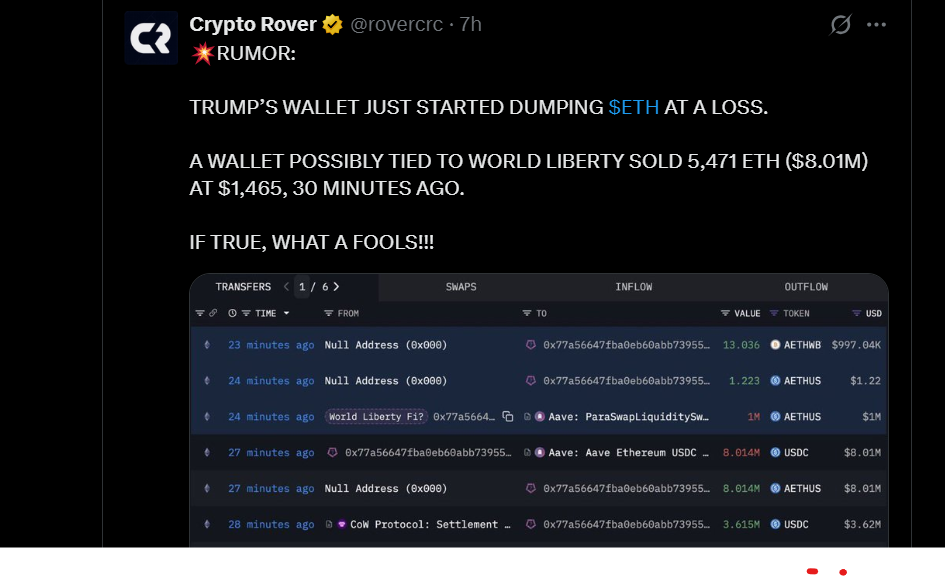
Speculation has it that Donald Trump’s DeFi project, World Liberty Financial, has offloaded its ETH wallets as Ethereum crashes.
Ethereum has hit a 2-year low price and a 58.86% drop since the beginning of 2025. The recent price crash has left major institutions dumping their ETH as open interest decreases.
According to Crypto Rover on X (formerly Twitter), a wallet supposedly belonging to Donald Trump, World Liberty Financial has dumped its ETH at a loss.
Source: X
What’s next for ETH?
While the market crash punishes ETH hard, some analysts believe the King of altcoins could be brewing its rebound. Some have argued that it’s time to buy ETH at 2018 prices. ETH’s derivatives data, Total Value Locked (TVL), and whale activity hint at a strong foundation. The altcoin could be down, but not entirely out in the long run.
A bounce-off above the $0.13 support level could see DOGE begin its uptrend momentum, while a breakdown could lead to further downside.
Dogecoin has been trading above a rising trend line on the weekly chart and fully respecting it since Q4, 2023. As of press time, DOGE was trading at $0.1424, a 5.8% dip in the last 24 hours, per CoinMarketCap. According to renowned crypto analyst, Ali Martnez on X (formerly Twitter), the $0.13 key resistance level on Dogecoin’s support line is a key psychological level.
Source: X
Why does the $0.13 zone matter?
At this level, the 61.8% Fibonacci retracement converges with Dogecoin’s support, making $0.13 both a technical and psychological battleground. As the crypto market fluctuates in panic, the meme-coin’s next direction could be defined in this zone.
One should keep an eye on this level, as Dogecoin’s average direction index remains neutral in the short term. Additionally, following smart money and whale activity in this zone could give further insights.
As institutional adoption rises, the crypto market could see a rebound fueled by new liquidity from traditional investors.
On the 8th of April,2025, Kranken partnered with Mastercard to bridge traditional finance and crypto assets. Kraken, one of the oldest, most liquid, and secure cryptocurrency platforms, secured this partnership in Paris, hoping to allow its users to spend their crypto assets to over 150 merchants globally.
According to David Ripley, the Kraken Co-CEO,
“Crypto is transforming the payments industry, and we envision a future where global commerce and everyday payments are powered by cryptoassets.”
So, what does this mean for the market?
Despite the recent market dip, this news is a reminder of how cryptocurrencies and blockchain technology go beyond speculative trading. While most crypto degens experience panic during bear markets, seeing digital assets for their real utility could instill long-term conviction while driving mass adoption.
Ripple Labs and Boston Consulting Group (BCG)’s recent report reveals a shift in traditional investment towards tokenized assets.
On the 7th of April, Ripple Labs and BCG released a joint report revealing an ongoing shift by traditional investors. According to the report, the traditional asset market is on a “three-phase evolution’ with 3 major financial giants on the move. These early adopters of real-world tokenized assets include BlackRock, Fidelity, and JPMorgan.
The report further added;
A “flywheel effect” is driving adoption, where institutional supply and investor demand reinforce each other.
Institutional adoption could fuel market growth
With most traditional investors cautious on decentralized finance (DeFi) markets, real-world assets(RWAs) could be their entry into this market. Similarly, adoption by traditional finance institutions builds trust among them. Capital inflow into tokenized assets could see the market hit $19 trillion by 2033, per Ripple Labs.
While the crypto market remains volatile, the RWA market could catalyze its maturity and stabilization in the long run. Tokenized assets are steadily rising in market capitalization and are a “must-watch” item in digital asset portfolios for the coming months.
Fartcoin has surged 20% in trading volume as open interest rises.
Fartcoin has faced renewed interest in the market as major cryptocurrencies face high price volatility. Over the last 24 hours, the meme-coin has surged 24% in price and was trading at $0.5722, at press time, per CoinMarketCap. On-chain metrics signal organic price growth based on low whale activity or price manipulation. The Solana meme-coin is showing strength as Wall Street bleeds more.
Open Interest (OI) Funding Rate turns positive
Looking at the current market sentiment, traders have unexpectedly shifted into buying this memecoin promising short-term gains. According to Coinglass, the OI-Funding Rate has turned positive in the past 48 hours, signalling trader optimism in Fartcoin’s bullish momentum.
Source: Coinglass
Looking at the technical indicators, Fartcoin’s moving averages flash a “strong buy” showing substantial buying pressure. With the Relative Strength Index (RSI) at 59, the memecoin is not yet overbought. This indicates more buying potential. However, one should be aware of the volatility in the meme-coin markets before making any moves.
What does the disconnect between President Trump’s claims and market sentiment suggest?
Popular prediction market, Polymarket, has predicted the chance of a U.S. recession as 61%, according to its latest update. However, the U.S president, Donald Trump, has kept his confidence in the U.S economy as indicated by his recent X (formerly Twitter) posts. Trump cites falling interest rates, low inflation, and strong tariffs as positive indicators of this.
Source: Polymarket
The contradiction in the market sentiment and Trump’s claims raises concerns about where the crypto and global finance stand in 2025.
Will the global market anxiety slow crypto growth?
A potential U.S recession could ripple across global economies, lowering investor confidence and digital asset demand while slowing trade. Traders could expect increased volatility in the crypto market over the next few weeks and months if global trade wars persist.
As traditional markets dip, fueled by recession fears, capital outflow from DeFi and blockchain projects is possible. This could plunge several altcoins. One should keep an eye on the progression of Trump’s trade tariffs for further insights.
The King of cryptocurrencies, Bitcoin, has found a strong support zone amid the current crypto market blood bath. BTC has faced significant price correction despite hitting $ 100k earlier this year. Per CoinMarketCap data, BTC was trading at $78.321k at press time.
With the global economy facing uncertainty and trade wars, traders wonder what’s next for Bitcoin as its price plunges.
The $ 74k-$70k zone is a strong support cluster
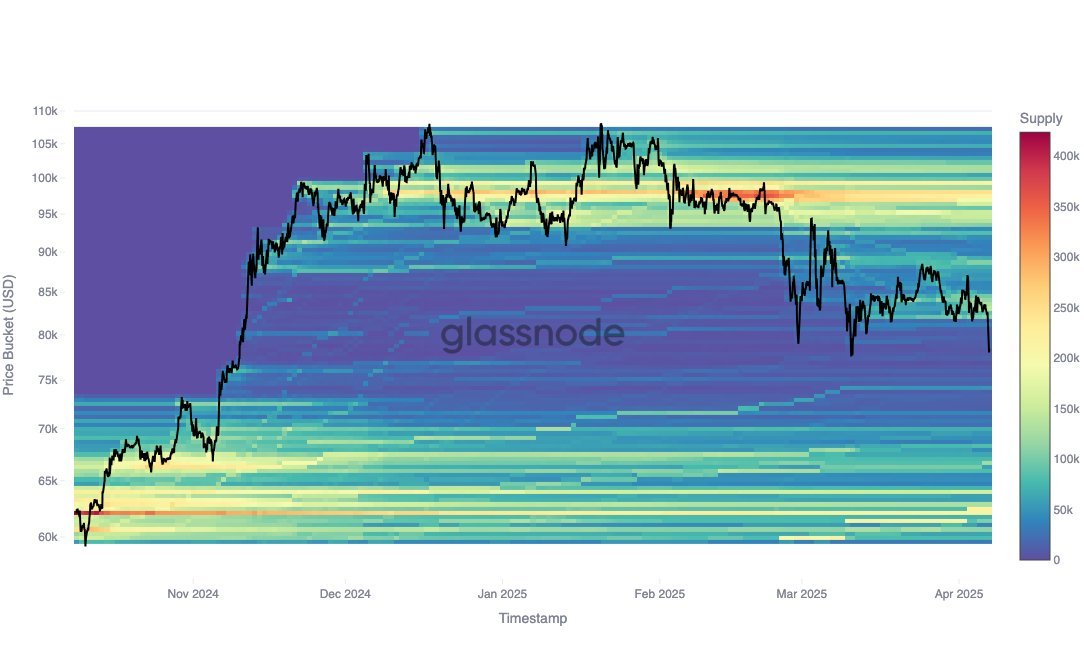
According to Glassnode data, traders hold over 175,000 BTC in the $74k-$70k zone, with the strongest pocket (50,000 BTC) sitting at $ 74.2k. Holders have been inactive since March 10, suggesting a “wait-and-see” sentiment. The $69.9k is another lower support band of Bitcoin’s cost basis, holding 68,000 BTC.
Source: Glassnode
Is it a Cooling-off period?
The King of crypto is trading below the Short-term holder (STH) cost basis of $89k. On-chain metrics suggest a historical cooling-off zone in bull markets. Market activity has decreased, with few new buyers. Traders seem to be waiting for a shift towards bullish market sentiment.
In a move that could send shockwaves through the cryptocurrency market, MicroStrategy is expected to announce a massive Bitcoin acquisition worth $21 billion, totaling over 500,000 BTC. The announcement is anticipated to come tomorrow morning, according to recent signals from CEO Michael Saylor.
Saylor, a vocal Bitcoin advocate and the face behind MicroStrategy’s bold crypto strategy, recently posted the “Saylor Bitcoin Tracker” on social media—a pattern historically followed by a major Bitcoin purchase the day after its appearance.
Strategic Timing
MicroStrategy is known for timing its Bitcoin buys during price pullbacks, and this upcoming purchase could align with a dip in the market. The company’s current Bitcoin holdings stand at approximately $8.73 billion, down from a peak of $19.5 billion, according to data from Bitcointreasuries.net and previous MicroStrategy filings.
If confirmed, this purchase would significantly expand MicroStrategy’s already industry-leading crypto portfolio and further solidify its position as the largest corporate holder of Bitcoin.
Market Impact
The potential acquisition of over 500,000 BTC would represent one of the largest single purchases in the history of digital assets. Analysts predict that such a move could drive strong bullish sentiment, possibly pushing Bitcoin’s price to new highs amid growing institutional interest.
MicroStrategy’s aggressive accumulation strategy has long been a bellwether for institutional adoption of Bitcoin. A $21 billion commitment would not only reaffirm the company’s confidence in the long-term value of BTC but could also influence other corporations to follow suit.
Looking Ahead
Investors and crypto enthusiasts are now eagerly awaiting the official announcement, which is expected early tomorrow. Should it be confirmed, the crypto markets could experience increased volatility and upward momentum as the news reverberates across trading platforms and financial institutions.
Stay tuned for updates on this potentially historic moment in Bitcoin’s journey toward mainstream adoption.
In a landmark move that could reshape the future of cryptocurrency regulation in the United States, the U.S. Securities and Exchange Commission (SEC) is hosting its first-ever Crypto Regulation Roundtable today. Organized by the SEC’s Crypto Task Force, the event began at 1 PM ET and is being viewed as a critical step toward establishing a more structured and transparent regulatory framework for the digital asset industry.
🇺🇸 TODAY: SEC Crypto Task Force will begin its first roundtable session to discuss key areas of interest in the regulation of crypto assets at 1 PM ET. pic.twitter.com/eroL2zO63L
The roundtable features a broad mix of participants, including:
Representatives from major cryptocurrency exchanges
Blockchain technology firms
Legal experts and compliance officers
Institutional investors
Academic researchers and economists
The objective of the meeting is to openly discuss the challenges and opportunities presented by digital assets, particularly around issues like token classification, investor protection, stablecoins, and decentralized finance (DeFi).
What’s on the Agenda?
Key topics expected to be addressed include:
How to define and classify digital assets
Strategies to ensure consumer and investor protection
The role of DeFi and how it fits within existing regulatory structures
Reporting requirements and compliance procedures for crypto platforms
Risks associated with stablecoins and leveraged products
Why It Matters
The SEC’s decision to engage in open dialogue with the industry is being welcomed by many as a shift from the agency’s historically enforcement-heavy approach to crypto. While several enforcement actions have marked the SEC’s stance over the past few years, this roundtable represents a willingness to listen, collaborate, and potentially adapt regulations to better fit emerging technologies.
Crypto advocates have long called for regulatory clarity, arguing that the lack of consistent guidelines stifles innovation and drives companies offshore. Today’s roundtable could mark a turning point in that conversation.
Looking Ahead
Although no immediate policy decisions are expected, the insights gained from this session are likely to influence upcoming regulatory proposals. The SEC has indicated that this roundtable is the first in a series of discussions aimed at building a more comprehensive approach to crypto oversight.
The outcome of today’s session could shape the direction of crypto regulation in the U.S. for years to come, signaling a more cooperative era between regulators and innovators in the digital asset space.